Your Retinoid Works Below the Neck Too: Chest, Hands, and Neck Without the Burn
Quick Answer: The same retinoid that resurfaces your face works on the neck, chest, and backs of the hands — these areas show sun-driven aging early and respond to the same mechanism. But they are not face skin: the neck and chest are thinner, with fewer oil glands and a slower barrier recovery, so they need a lower frequency, a buffer, and more patience — start once weekly, moisturizer-sandwiched, and build slowly. Hands tolerate more but wash it off constantly, so application timing is the whole game there. Daily SPF on every treated zone is non-negotiable, and results run slower than the face — think seasons, not weeks.
Done with the volume turned down, it is the highest-yield expansion in skincare. Done at face settings, it ends in a necklace of irritation by day ten.
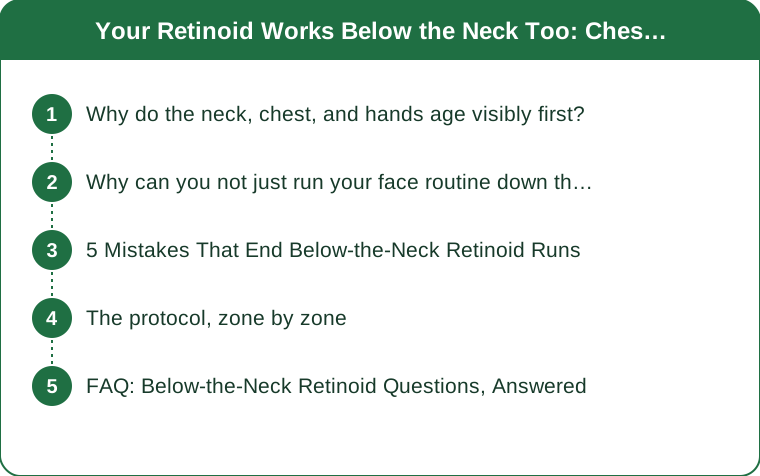
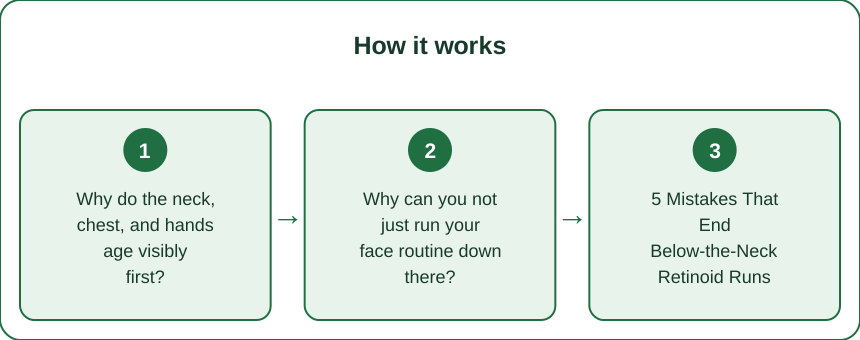
Why do the neck, chest, and hands age visibly first?
Maximum exposure meeting minimum defense — a bad combination they did not choose.
The exposure half: these zones log nearly face-level sun across a lifetime — necklines, open collars, and the backs of hands on steering wheels collect ultraviolet daily, year-round. But the face gets decades of SPF, moisturizer, and active ingredients while the neck gets whatever the face routine dripped, the chest gets summer-only attention, and the hands get soap forty times a day. Same weather, none of the maintenance.
The defense half: the skin itself is structurally weaker there. Neck and chest skin is thinner than face skin, with markedly fewer sebaceous glands — less natural oil means a drier surface, a more fragile barrier, and slower recovery from any insult, including the deliberate mild insult a retinoid represents. Hands add their own tax: relentless washing strips the barrier daily, which is why hand skin ages on an accelerated schedule despite being tougher tissue.
The result is the familiar mismatch — a well-maintained face above a chest with sun-crinkling and a neck showing texture and laxity, with hands announcing decades the face declines to confirm. Photodamage is the dominant author of all of it, which is exactly why these zones are strong retinoid candidates: the mechanism that helps sun-damaged face skin — accelerated turnover and, over long horizons, support for collagen — is the mechanism these areas have been missing.
The catch is that the delivery rules were written for the face, and the face is the most resilient canvas of the four.
Why can you not just run your face routine down there?
Because tolerance is a property of the skin, not the product — and this skin has less of it.
Retinoid irritation — dryness, flaking, sting, the retinization adjustment weeks — is managed on the face by decent oil production and a comparatively robust, fast-recovering barrier. The neck and chest bring neither. The same product, at the same frequency that a face sails through, routinely produces on the neck a red, flaky, stinging band — the classic necklace-line irritation — a week or two in. The chest, with clothing friction and sweat on top, can do worse.
There is also a mechanical difference nobody warns about: the neck folds. Faces mostly hold still; necks crease, turn, and compress against pillows and collars, and product concentrates in those moving folds — delivering an accidental double dose precisely along the horizontal lines being treated. Thin application matters more here than anywhere on the face.
Hands fail differently. Their skin is thicker and tolerates retinoids comparatively well — but everything applied before bedtime meets the evening’s final handwashes, which is why hand retinoid so often does nothing: it was rinsed off before it worked. The hand problem is scheduling, not sensitivity.
And a shared aggravator across all three zones: damp application. Product on shower-damp skin penetrates faster and stings harder — a tolerable variable on the face, a miserable one on the neck. Fully dry skin, always, below the jaw.
Same active, three different terrains. The protocol shifts terrain by terrain, which is the entire skill of the expansion.

5 Mistakes That End Below-the-Neck Retinoid Runs
Starting at face frequency. Nightly-tolerant faces convince people to start the neck nightly; the necklace of irritation arrives within two weeks and the whole project gets abandoned as impossible. The neck starts at once weekly. There is no prize for arriving faster than your barrier.
Skipping SPF on the newly treated zones. Retinoids increase sun sensitivity, and the neck, chest, and hands are high-exposure real estate — treating them at night while leaving them bare to UV all day is rowing against the current and collecting irritation for the privilege. Morning SPF on every treated area is part of the treatment, not an accessory to it.
Applying to damp post-shower skin. The evening-shower-then-routine pipeline delivers the active onto damp thin skin — maximum penetration, maximum sting. Wait until fully dry; twenty impatient minutes saves the whole run.
Forgetting hands wash themselves clean. Hand cream ritual logic — apply whenever — fails for actives. Hand retinoid goes on at true lights-out, after the final wash, with plain moisturizer over it; some add cotton gloves on treatment nights, which is optional but effective.
Quitting at the week-two flake. Mild adjustment flaking on the chest and neck arrives on schedule and passes; the error is reading it as failure rather than the known toll gate. The correct response is holding frequency or stepping back one notch — not abandonment, and not pushing through visible raw redness, which is the other, equal mistake.
The protocol, zone by zone
One product, three terrains, four rules each.
Neck: a pea-sized amount for the entire area — genuinely thin — on completely dry skin, starting once weekly, sandwiched: moisturizer first, retinoid over it, moisturizer again. The sandwich blunts penetration speed, which is the point on thin terrain. Hold once-weekly for a month; progress to twice weekly only when the previous month ran calm. Twice or three times weekly is a fine permanent ceiling — consistency at low frequency beats ambition at high.
Chest: same sandwich, same once-weekly start, timed away from friction — not the night before a sports bra day or a high-necked workout top, since fabric rubbing on adjusting skin multiplies irritation. Many settle at once or twice weekly permanently; sun-crinkled chests respond meaningfully even at that dose, on a timescale of months.
Hands: after the final handwash of the night, thin layer, plain moisturizer over, lights out. Tolerance usually allows two to three nights weekly fairly quickly. Daytime, SPF on the backs of hands — the driving-hand habit — is half the entire result.
Everywhere: the lower-strength or gentler formulation you have outgrown on your face is exactly right below it; over-the-counter retinol strengths are the sensible starting tier for body zones even for prescription-strength faces. Expect the timeline stretched — twelve weeks for early texture change, seasons for the real shift — because turnover runs slower off the face.
And the boundaries: pregnancy and nursing are a stop on retinoids pending your doctor’s guidance; raw, broken, or rash-bearing skin is not a treatment surface; and new or changing spots on sun-exposed chest and hands are dermatologist territory before they are skincare territory. This is cosmetic guidance, not medical advice — the professionals outrank the routine.
FAQ: Below-the-Neck Retinoid Questions, Answered
Do I need a separate body retinol product?
Not necessarily — the face product works, used thinner and less often, though dedicated body formulations buy you gentler vehicles and easier coverage for larger areas at lower cost per use. The honest hierarchy: frequency and SPF discipline first, product choice a distant second.
Can I work out the morning after treating my chest?
Yes, with clothing sense: adjusting chest skin plus tight synthetic necklines plus sweat is the friction trifecta, so schedule chest nights before rest days or low-sweat days during the first month. Once the zone is calm and established, workout scheduling stops mattering.
Does it help the rough bumps on the backs of my arms?
That pattern is commonly keratosis pilaris, and retinoids are one of the tools that can soften it — though chemical exfoliants and plain consistent moisturizing are the usual first line, and genetics writes the ceiling. Same low-and-slow body rules apply if you try it there.
I am pregnant — can I keep treating my neck and hands?
Retinoids across the board are conventionally paused during pregnancy and nursing — including body use — as a precaution; this is a decision to make with your OB, not a blog. The zones will wait, and SPF plus moisturizer holds the line beautifully in the meantime.
TL;DR:
- Neck, chest, and hands collect face-level sun with none of the face’s maintenance — and their thinner, drier, slower-recovering skin is why face-frequency retinoid use fails there.
- The protocol is low and slow: pea-sized on bone-dry skin, moisturizer-sandwiched, once weekly to start, twice or three times as a ceiling; hands go on after the final wash of the night.
- Daily SPF on every treated zone is half the result; damp skin, friction nights, and the week-two flake are the run-enders to plan around.
- Timelines run in seasons, pregnancy pauses everything, and changing spots see a dermatologist first.
Start this week with one zone and one night — neck, Sunday, sandwiched. By the time the fall wardrobe goes high-necked, the adjustment weeks will already be behind you.
See It in Motion
Seen here: Racerback Tank Top - White — shop similar styles on bubblelime.com
Keep Reading
This article is for general informational and styling purposes only. Fit, sizing, and product availability may vary.