Why Different Parts of Your Face Need Different Amounts of Retinoid
Quick Answer: Facial skin thickness varies dramatically — the eyelid area is around 0.5mm while the skin over the cheeks and forehead is several times thicker, and the nose has both thicker skin and far more sebaceous glands. Sebum dilutes and disperses a retinoid; thin skin absorbs more of it faster. An even layer therefore over-treats the delicate areas and under-treats the oily ones. Apply by zone rather than by whole face.
This is why so many people get irritation around the mouth and eyes while their nose does nothing at all.
And it is a technique problem, not a product problem.

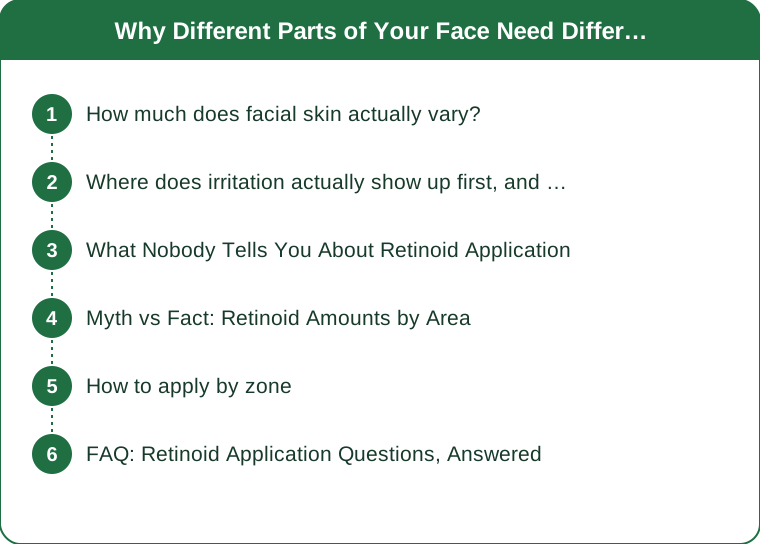
How much does facial skin actually vary?
Enough to change the outcome completely.
Skin thickness across the face is not remotely uniform. The eyelid skin is the thinnest on the body at roughly 0.5mm. The skin around the mouth and nasolabial folds is also relatively thin and moves constantly. The cheeks, forehead and nose are meaningfully thicker.
Thicker skin means the active has further to travel and more barrier to cross. Thinner skin means faster, deeper penetration of the same amount of product.
Then there is oil. The T-zone — forehead, nose, chin — carries the highest density of sebaceous glands on the face. Sebum both dilutes a topical product and changes how it spreads, which reduces the effective concentration reaching the skin.
So you have two gradients running in opposite directions: thin, dry, low-oil areas absorbing efficiently, and thick, oily areas absorbing poorly. An even application across both is a compromise that suits neither.
Where does irritation actually show up first, and why?
Almost always in the same three places, for the same reason.
Around the mouth and the nasolabial folds. Thin skin, constant movement, and — critically — this is where product tends to pool as it is spread across the face. The corners of the mouth catch product from every direction.
Under and beside the eyes. The thinnest skin on the face, and it also receives migrated product as the retinoid spreads and as you sleep.
The neck. Thinner than facial skin, fewer oil glands, and typically far less accustomed to actives.
Meanwhile the nose — where many people most want the effect — sits under a layer of sebum in the thickest, most resilient skin on the face, and frequently shows the least response of anywhere.
The common experience of my retinoid irritates me and does not seem to be doing much is often both of those things happening simultaneously, in different places, for the same reason.
What Nobody Tells You About Retinoid Application
A pea-sized amount is a guideline, not an instruction. The commonly repeated pea-sized amount for the whole face is a reasonable average, and it is spread unevenly by almost everyone. Where it lands matters as much as how much there is.
Application order changes distribution. Most people start where their hand naturally goes — usually the cheeks — and by the time they reach the T-zone there is very little left on the fingertips. So the area that needed most got least. Starting at the nose and forehead reverses this entirely.
Buffering works, and it works unevenly. Applying moisturiser before a retinoid reduces irritation, which is genuinely useful. It also reduces penetration, so buffering the whole face means buffering areas that did not need it. Buffer the thin areas and leave the T-zone unbuffered.
And the detail that surprises people: a retinoid migrates overnight. Product applied close to the eye or the corner of the mouth moves further as you sleep, particularly if you sleep on your side. That is why the irritation is often slightly below where you applied it, and why leaving a genuine gap matters more than people expect.

Myth vs Fact: Retinoid Amounts by Area
Myth: You should use the same amount everywhere for even results.
Fact: Even application produces uneven exposure, because the skin is not even. Zonal application produces more consistent actual dosing.
Myth: Irritation means the strength is too high.
Fact: Sometimes. Very often it means the distribution is wrong — too much reaching thin areas. Many people who reduce strength would have done better to change technique, and end up with a product that is now too weak for the areas that were already under-treated.
Myth: Avoiding the eye area entirely is safest.
Fact: A sensible gap is wise, and the orbital area does respond to careful use of appropriate products. The issue is quantity and migration, not proximity in principle.
Myth: If the nose is not responding, you need a stronger product.
Fact: You may simply need to apply to clean, dry skin and give the nose its own dose — going stronger everywhere to fix one zone is how people end up irritated everywhere else.
How to apply by zone
A practical routine that takes no longer than the usual one.
1. Cleanse and wait. Apply to genuinely dry skin — waiting 10 to 20 minutes after cleansing reduces stinging noticeably, because damp skin absorbs more and faster.
2. Start at the T-zone. Nose, forehead, chin first, while your fingertips have the most product. These areas are thickest and oiliest and need the most.
3. Cheeks next, with what remains.
4. Leave a deliberate gap. Roughly 1cm around the eyes and at the corners of the mouth. Product migrates into these areas on its own.
5. Buffer the thin areas only. Moisturiser around the mouth and outer eye area before the retinoid; leave the T-zone unbuffered.
6. Moisturise over the top once the retinoid has absorbed, everywhere.
If one zone is irritated and another is not, treat them on different schedules — T-zone nightly, thin areas every third night. There is no rule that says the whole face must be on the same frequency, and this single adjustment resolves a great many long-running problems.
This is general information, not medical advice. If you have persistent irritation, a skin condition, or you are pregnant or trying to conceive, speak to a doctor or dermatologist about retinoid use.
FAQ: Retinoid Application Questions, Answered
Can I really use different frequencies on different parts of my face?
Yes, and it is one of the more useful adjustments available. Nightly on the T-zone and every second or third night around the mouth and eyes is a common and sensible pattern.
Should I use more product on the nose because of the oil?
Slightly more, and more importantly apply it to properly dry skin and first in the sequence. A gentle cleanse that removes surface oil without stripping helps considerably.
Why does my chin get irritated when my forehead does not?
The chin moves constantly, is often touched, and frequently receives product from two directions as you apply. It is one of the classic pooling zones.
Does this apply to the neck too?
Yes, and the neck deserves its own reduced schedule — thinner skin, fewer oil glands, and much less tolerance. Twice a week is a reasonable starting point there, even if your face tolerates nightly.
TL;DR:
- Facial skin thickness and oil density vary enormously, so even application means uneven dosing
- Thin areas — around the mouth, eyes, and neck — over-absorb and are where irritation appears
- The T-zone under-absorbs because sebum dilutes and disperses the product
- Start application at the nose and forehead, leave a 1cm gap around eyes and mouth, and buffer only the thin areas
- Different zones can run on different frequencies
Before you drop to a weaker retinoid because of irritation, try changing where you start applying it. Most people find the irritation was concentrated in two small areas that were getting several times the dose they needed.
Keep Reading
This article is for general informational and styling purposes only. Fit, sizing, and product availability may vary.