Why How You Apply a Retinoid Changes the Dose Your Skin Gets
Quick Answer: A pea-sized amount is the standard dose for a whole face, and most people use two to four times that without realising. Applying to damp skin increases penetration; spreading with fingertips versus palms changes how much is absorbed versus wasted; and dotting-then-spreading concentrates product where you dotted. All of these shift the effective dose, which is why the same product irritates one person and does nothing for another.
You bought the same strength your friend uses. Theirs is going beautifully. Yours has been peeling for three weeks.
Same molecule, same percentage, same nightly frequency.
Different amount actually delivered into the skin — and almost none of that difference comes from the bottle.
What actually determines how much retinoid your skin receives?
Four variables, only one of which is printed on the packaging.
Concentration — the number on the label. This is the one everyone compares.
Quantity applied — how much product leaves the tube. A pea-sized amount is roughly 0.25g and is the standard for a full face. Applying half a fingertip’s worth can easily be double that.
Skin condition at application — damp skin absorbs more than dry skin. Freshly cleansed, still-moist skin has a compromised barrier and higher permeability. This alone can meaningfully change how much gets through.
Distribution — where the product actually ends up. Product left on fingertips, absorbed into a cotton pad, or concentrated in one area is not evenly dosing your face.
The consequence: two people using identical 0.5% products can differ several-fold in delivered dose. The percentage on the box is the least variable part of the equation.
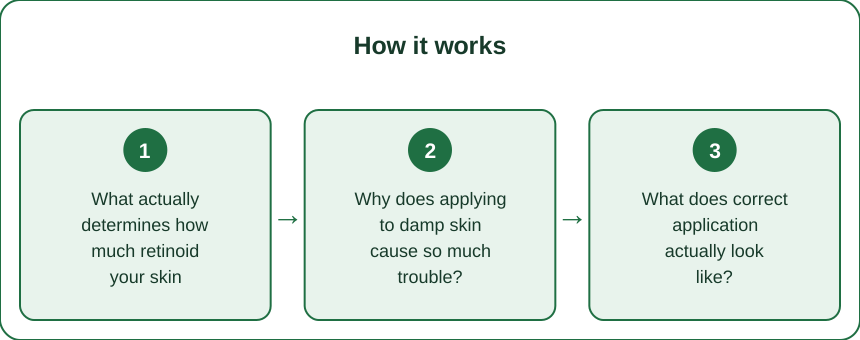
Why does applying to damp skin cause so much trouble?
Because water temporarily increases how permeable your skin barrier is.
A hydrated stratum corneum swells slightly, its structure loosens, and penetration of applied actives increases. For a moisturiser, this is desirable. For a retinoid, it is an unplanned dose increase.
The classic scenario: you cleanse, pat dry, and apply within thirty seconds because that is what you do with everything else. The skin is still damp. The retinoid penetrates faster and further than the product was formulated for, and you get irritation that seems disproportionate to the strength.
The fix is simply to wait. Most dermatology guidance suggests waiting 10 to 20 minutes after cleansing before applying a retinoid, specifically so the skin returns to baseline hydration.
This single change resolves a large share of unexplained retinoid irritation, and it costs nothing but patience.
What does correct application actually look like?
Six steps, in order:
1. Cleanse and wait. Ten to twenty minutes. Do something else in the meantime.
2. Dispense a pea-sized amount. For the whole face. If it looks like too little, it is probably right.
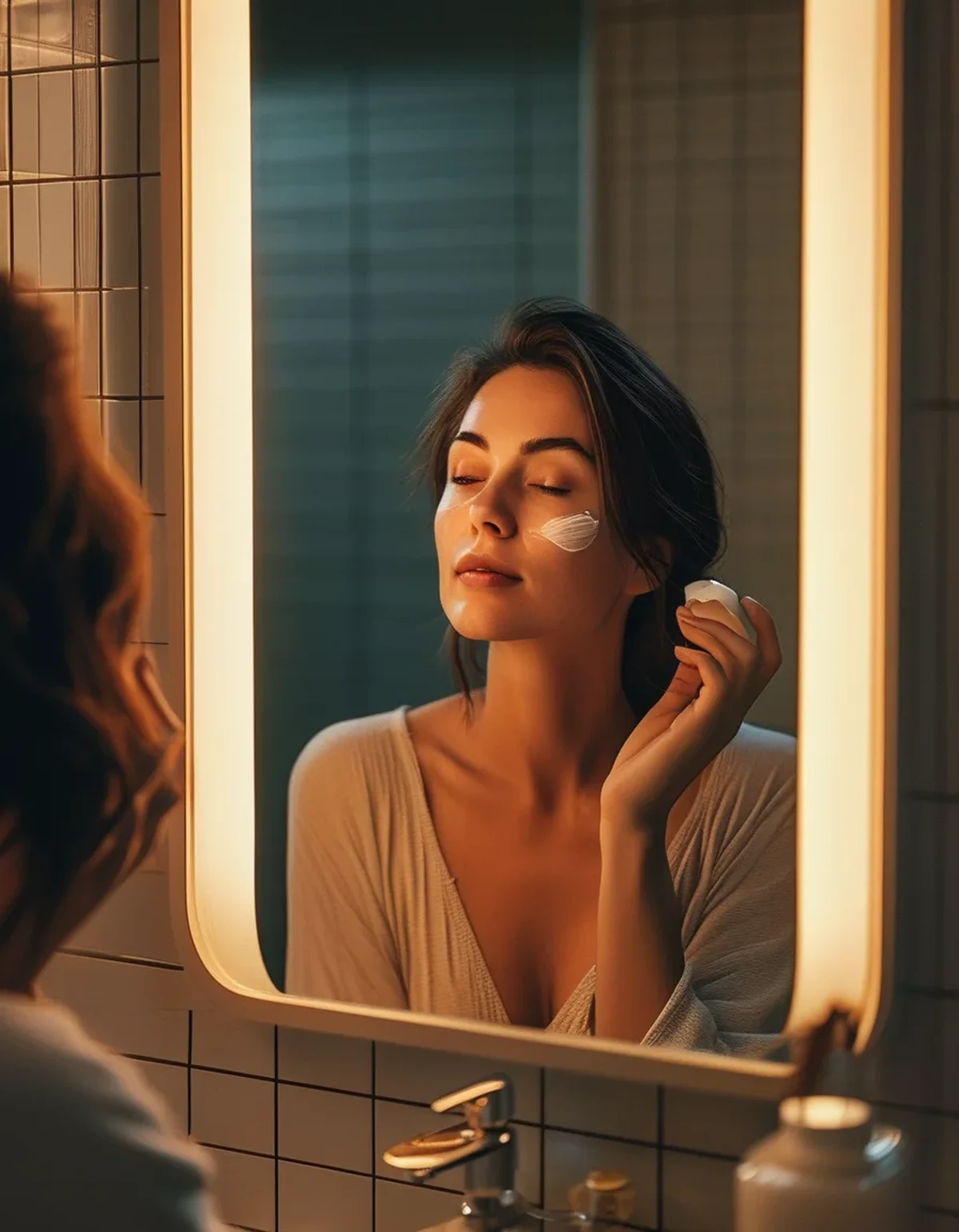
3. Dot it across five points — forehead, both cheeks, nose, chin — before spreading anything. Dotting first ensures even distribution; spreading from one point concentrates dose where you started.
4. Spread with fingertips in thin, even layers. Avoid the immediate eye area, the corners of the nose and the corners of the mouth, where skin is thinner and product pools.
5. Do not rub in aggressively. Mechanical irritation adds to chemical irritation.
6. Moisturise after, or sandwich. Applying moisturiser before and after — the sandwich method — reduces irritation with only a modest reduction in effect, and it is a reasonable trade during adjustment.
What most people get wrong: step two and step three. More product and a single starting point together produce a face that is over-dosed in some areas and under-dosed in others.
Myth vs Fact: Retinoid Application
Myth: More product means faster results. Fact: above the amount needed to cover the skin, extra product does not increase the biological effect — it increases irritation. The receptor sites saturate.
Myth: If it does not sting, it is not working. Fact: irritation and efficacy are not the same thing. Well-tolerated consistent use over months outperforms aggressive use with frequent breaks.
Myth: Applying to damp skin helps it absorb better. Fact: it does absorb better, which is the problem. Better absorption than the formulation assumes means a higher effective dose and more irritation.
Myth: Applying moisturiser first blocks it completely. Fact: buffering reduces penetration somewhat but does not eliminate it. It is an established strategy for building tolerance, not a way of wasting the product.
Does the autumn change require an application change too?
Yes, and it is the season when most people are restarting after a summer off.
Humidity drops. Lower ambient humidity means skin loses water faster, the barrier is drier, and the same retinoid dose is less well tolerated. This is the main reason autumn restarts go badly.
Indoor heating arrives. Heated indoor air is very dry, and it affects overnight skin condition directly — which is exactly when your retinoid is working.
Hot showers return. Hot water strips lipids and leaves the barrier more permeable and more reactive. Retinoid applied after a hot shower stings more for a real physiological reason.
Practical autumn adjustments:
- Extend the wait after cleansing to closer to 20 minutes as humidity falls.
- Use the sandwich method for the first few weeks of the season, then taper back if tolerated.
- Reduce frequency before reducing strength. Twice a week at your usual strength builds tolerance better than nightly at a lower one.
- Keep sunscreen going. Autumn UV is lower but not zero, and retinised skin remains more photosensitive.
FAQ: Retinoid Application Questions, Answered
Is a pea-sized amount really enough for a whole face?
Yes. It is the amount used in clinical studies for full-face application. It looks insufficient because most cosmetic products are used far more generously.
Should I apply to the eye area?
Follow your product’s guidance. Many prescription retinoids advise avoiding the immediate orbital area; some formulations are designed for it. The skin there is thinner and more reactive either way.
Can I use the same amount on my neck and chest?
Use a separate pea-sized amount for the neck and chest rather than whatever is left on your fingers. Those areas need their own dose and are typically more sensitive than facial skin.
How long until application changes show a difference?
Irritation improvements often appear within one to two weeks of correcting technique. Efficacy changes take longer to judge — give any routine change 12 weeks before drawing conclusions.
This is general information, not medical advice. Persistent irritation, severe peeling, or reactions to a prescription retinoid should be discussed with the prescriber.
TL;DR:
- Effective dose depends on concentration, quantity, skin dampness and distribution — and only the first is on the label.
- A pea-sized amount covers a whole face; most people use two to four times that.
- Wait 10 to 20 minutes after cleansing — damp skin absorbs more than the formulation assumes, and this alone causes a lot of unexplained irritation.
- Dot at five points, then spread, and moisturise after or sandwich during adjustment.
- Autumn’s falling humidity, indoor heating and hot showers all reduce tolerance — extend the wait, buffer, and cut frequency before strength.
The bottle is one variable out of four. The other three happen at the bathroom mirror, and they are the ones you actually control.
Keep Reading
This article is for general informational and styling purposes only. Fit, sizing, and product availability may vary.