Why Your Retinoid Routine Needs to Change When You Travel, Even for a Short Trip
Quick Answer: Travel often combines increased sun exposure, climate shifts, and disrupted sleep — all factors that make skin more reactive to retinoids — so scaling back frequency or pausing use during a trip, especially a sun-heavy one, reduces the risk of irritation that a stable at-home routine doesn’t usually create.
A retinoid that’s been well-tolerated for months at home can suddenly cause irritation mid-trip, and it’s rarely the product itself that changed.

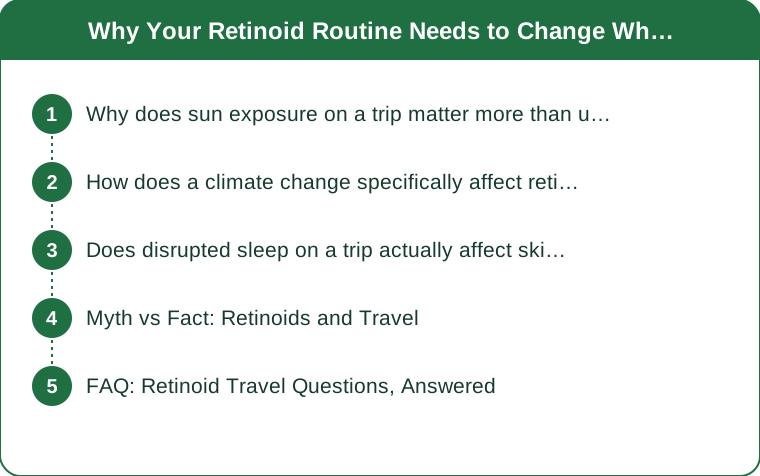
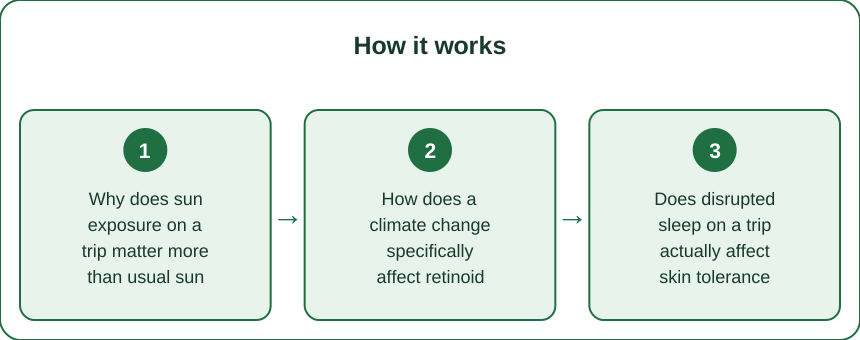
Why does sun exposure on a trip matter more than usual sun exposure at home?
Retinoids increase photosensitivity, and vacation-level sun exposure — often several consecutive hours outdoors — is a different category of exposure than typical daily incidental sun, meaningfully raising the risk of irritation or a sunburn-like reaction on retinoid-treated skin.
How does a climate change specifically affect retinoid tolerance?
Moving from a humid home climate to a dry destination (or vice versa) changes your skin barrier’s baseline hydration, and retinoids already thin the outer skin layer slightly, so a sudden climate shift can push already-sensitized skin into visible irritation faster than it would at home.
Does disrupted sleep on a trip actually affect skin tolerance too?
Yes — poor sleep is linked to a weaker skin barrier function, and since retinoids work partly by temporarily increasing skin cell turnover, a compromised barrier from travel-disrupted sleep has less buffer against that increased turnover, making irritation more likely even without a change in product usage.
Myth vs Fact: Retinoids and Travel
Myth: Retinoid tolerance is only about the product and your skin type. Fact: External factors like sun exposure, climate, and sleep quality meaningfully affect tolerance too.
Myth: You should never pause a retinoid routine once it’s established. Fact: A short pause during a sun-heavy or climate-shifting trip is a reasonable precaution, not a setback to your progress.
Myth: Sunscreen alone fully offsets the added photosensitivity risk. Fact: Sunscreen helps significantly but doesn’t eliminate the increased sensitivity retinoids create, especially during extended outdoor exposure.
FAQ: Retinoid Travel Questions, Answered
Should I stop my retinoid a few days before a sun-heavy trip?
Many dermatologists suggest pausing 2-3 days before and during a sun-heavy trip, though this depends on your individual sensitivity and destination.
Is it fine to resume at full frequency immediately after returning home?
Easing back in at your previous frequency after a few days of normal skin behavior is generally fine, rather than an extended reintroduction period.
What if my trip doesn’t involve much sun exposure at all?
For low-sun, climate-stable trips, many people can maintain their normal retinoid routine without issue — the main concerns are specifically sun exposure and significant climate or sleep disruption.
TL;DR:
- Vacation-level sun exposure meaningfully raises retinoid-related photosensitivity risk
- Climate shifts change your skin barrier’s baseline hydration, affecting tolerance
- Travel-disrupted sleep weakens barrier function, making irritation more likely even without dosage changes
- Pausing or reducing frequency for a sun-heavy or climate-shifting trip is a reasonable precaution
Before your next trip, plan your retinoid schedule around the destination, not just your usual routine — a short pause now avoids a much worse irritation flare-up later.
Keep Reading
This article is for general informational and styling purposes only. Fit, sizing, and product availability may vary.