Why Your Retinoid Routine Has to Change as the Humidity Drops
Quick Answer: Retinoid tolerance depends heavily on skin barrier condition, and barrier function tracks environmental humidity. As outdoor humidity falls and indoor heating starts, your skin loses water to the air faster, the barrier gets less resilient, and the same concentration at the same frequency produces more irritation than it did in summer. The fix is rarely to stop - it is to change the buffering, frequency, and supporting routine before the irritation arrives rather than after.
Here is the seasonal mechanism and the adjustments that actually work.

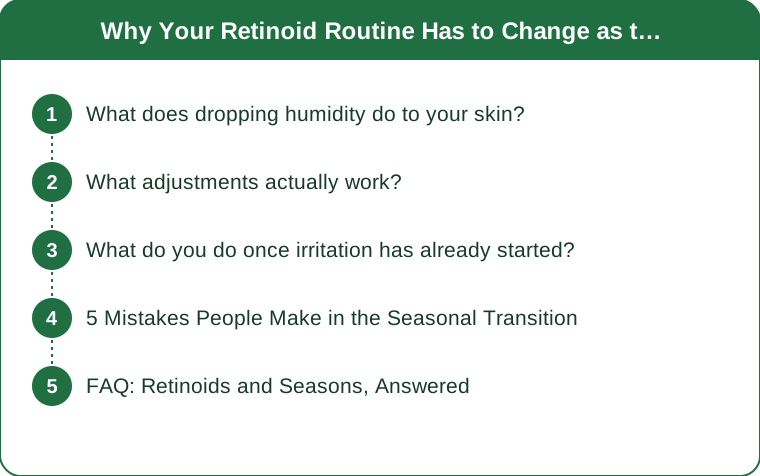
What does dropping humidity do to your skin?
Water loss is the mechanism, and everything else follows from it.
Transepidermal water loss increases when ambient humidity drops. The drier the surrounding air, the steeper the gradient pulling moisture out of your skin. Same skin, more loss.
Indoor heating makes it worse than outdoors. Heated indoor air is often considerably drier than the outdoor air it came from, and you spend most of your day in it. The change people attribute to the weather is frequently the radiators.
A drier barrier is a less resilient barrier. The skin’s outer layer needs adequate water content for its enzymatic processes and its structural integrity. When it dries, it becomes more permeable and more reactive to everything you apply.
And retinoids work partly by increasing cell turnover, which is exactly the process a compromised barrier struggles to support. The active did not change strength - your skin’s capacity to accommodate it did.
Which is why the classic pattern appears in autumn: months of comfortable retinoid use, then a fortnight of unexplained flaking, tightness, and stinging with no change in product. The product was never the variable.
Hot showers and hot water compound it, and hot showers become more appealing in exactly the same weeks. Several small seasonal shifts stack in the same direction at once.
What adjustments actually work?
In order of effectiveness, and none of them require stopping.
Reduce frequency before reducing strength. Going from nightly to every third night is usually more effective than switching to a weaker product, because it gives the barrier recovery time between exposures. Rebuild frequency slowly once tolerance returns.
Buffer with moisturiser. Apply moisturiser first, wait, then apply the retinoid on top - or mix the retinoid into moisturiser. Both reduce irritation meaningfully, and neither eliminates the benefit.
Apply to completely dry skin. Damp skin increases penetration and increases irritation with it. Wait around 20 minutes after cleansing - this is one of the highest-value, lowest-cost adjustments available, and almost nobody does it.
Move to a richer moisturiser for the season. A lotion that was right in humid August is frequently insufficient by October. Look for a cream with occlusive and humectant components rather than a lighter gel.
Reduce everything else that challenges the barrier. Exfoliating acids, scrubs, strong cleansers, and hot water. Retinoid plus acid is far more demanding in dry air than it was in humid air, and one of them needs to give ground.
And apply less than you think. A pea-sized amount for the whole face is genuinely enough. Irritation is frequently a dosing problem dressed up as a tolerance problem.

What do you do once irritation has already started?
Stop adding, restore the barrier, then rebuild - in that order.
Pause the retinoid rather than pushing through. Retinisation - an initial adjustment period - is real, but ongoing stinging, burning, persistent redness, or peeling weeks into use is not the adjustment period. It is barrier damage.
Simplify to a minimal routine for one to two weeks. Gentle cleanser, plain moisturiser, sunscreen in the morning. Nothing active. The barrier repairs given the chance and no further challenge.
Use products with barrier-supporting ingredients - ceramides, cholesterol, fatty acids, and humectants like glycerin. Avoid fragrance and essential oils entirely while recovering, since compromised skin reacts to things it previously tolerated.
Restart at a lower frequency than before, not the same. Twice weekly, buffered, on dry skin. Returning to nightly use straight after recovery reliably reproduces the problem.
And be strict about sunscreen throughout. Retinoid use increases photosensitivity, and a compromised barrier is more vulnerable. Autumn sun feels weaker and UV exposure is still meaningful - and this is precisely the season people quietly stop applying it.
One clarifying point on peeling: light initial flaking is a normal part of early retinoid use. Painful, ongoing peeling with redness and stinging is not, and the distinction is whether it settles within a few weeks or keeps escalating.
This is general information, not medical advice. If you have persistent irritation, a diagnosed skin condition such as eczema or rosacea, you are pregnant or trying to conceive, or you use prescription retinoids, speak to a dermatologist or pharmacist rather than adjusting on your own - retinoid use in pregnancy in particular needs professional guidance.
5 Mistakes People Make in the Seasonal Transition
1. Keeping the exact summer routine into autumn. The routine was calibrated to different air. Reassessing moisturiser weight and retinoid frequency twice a year is normal maintenance, not fussiness.
2. Applying retinoid to damp skin. It feels efficient straight after cleansing and it substantially increases irritation. Twenty minutes of drying time is the whole fix.
3. Adding an exfoliant because the skin looks flaky. The flaking is barrier disruption, and exfoliating disrupted skin makes it worse. Moisturise; do not sand.
4. Pushing through escalating irritation. The initial adjustment period is real, but it settles. Irritation that keeps worsening is damage, and continuing through it lengthens the recovery considerably.
5. Dropping sunscreen once summer ends. UV exposure remains meaningful in autumn, retinoids increase photosensitivity, and a compromised barrier is more vulnerable than usual. This is the season people stop, and it is the season it matters most.
And the one that surprises people: turning the bedroom heating down slightly, or running a humidifier at night, can do more for retinoid tolerance than any product change. Your skin spends seven or eight hours in that air with the active on it - the room is part of the routine whether you treat it as one or not.
FAQ: Retinoids and Seasons, Answered
Why does my retinoid irritate me in autumn when it was fine all summer?
Lower humidity and indoor heating increase water loss from your skin, which reduces barrier resilience. The product is identical; your skin’s capacity to accommodate it has changed.
Should I stop using my retinoid in winter?
Usually not. Reducing frequency, buffering with moisturiser, and switching to a richer cream generally resolves the issue without giving up the benefits.
Is it better to reduce strength or frequency?
Frequency first. Spacing applications gives the barrier recovery time between exposures, which addresses the actual problem more directly than a weaker formula does.
How long should I wait after cleansing?
About 20 minutes, until the skin is completely dry. Applying to damp skin increases penetration and irritation, and this single change resolves a surprising number of tolerance problems.
Is peeling normal?
Light flaking in the first few weeks is a common part of adjustment. Ongoing painful peeling with redness and stinging is barrier damage and needs a pause, not persistence.
Do I still need sunscreen in autumn?
Yes. UV exposure remains meaningful, retinoids increase photosensitivity, and a stressed barrier is more vulnerable - which makes autumn the worst season to stop.
TL;DR:
- Falling humidity and indoor heating increase water loss from your skin, which reduces barrier resilience.
- A less resilient barrier is more permeable and more reactive - so the same retinoid at the same strength irritates more.
- Reduce frequency before strength, and buffer by applying moisturiser first or mixing the retinoid into it.
- Apply to completely dry skin - wait about 20 minutes after cleansing. Highest-value adjustment there is.
- Move to a richer cream for the season and pull back on acids, scrubs, and hot water at the same time.
- If irritation has started: pause, simplify for one to two weeks, use barrier-supporting ingredients, then restart at lower frequency.
- Do not drop sunscreen in autumn - photosensitivity plus a stressed barrier is the worst combination to leave unprotected.
A humidifier at night can outperform any product swap you were considering.
This is general information, not medical advice.
Keep Reading
This article is for general informational and styling purposes only. Fit, sizing, and product availability may vary.