Why Your Retinoid Routine Works Great in Winter and Irritates Your Skin All Summer
Quick Answer: Retinoids increase skin’s sensitivity to UV light and slightly compromise the skin barrier as part of how they work, and summer’s higher humidity, sweat, and sun exposure combine with that increased sensitivity in ways winter’s drier, lower-UV conditions don’t — meaning the same product and dose can be well-tolerated in winter and genuinely irritating in summer.
A routine that worked fine for months isn’t ‘suddenly wrong’ when summer irritation shows up — the season itself changed the equation.
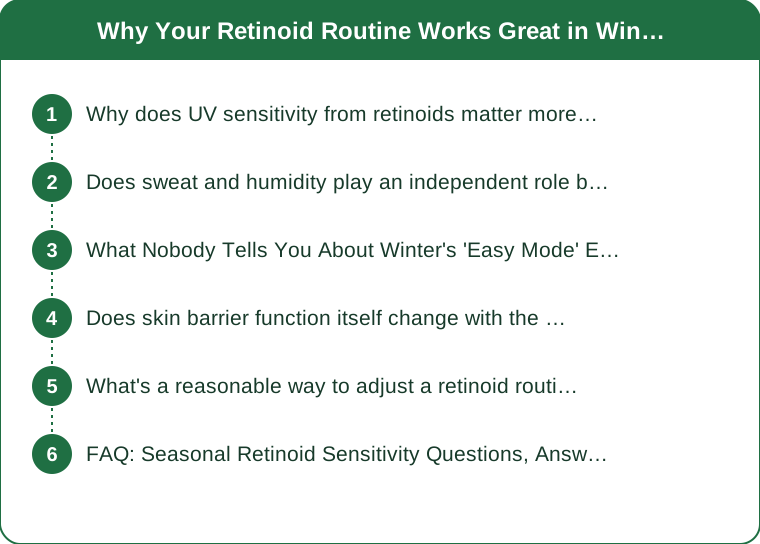
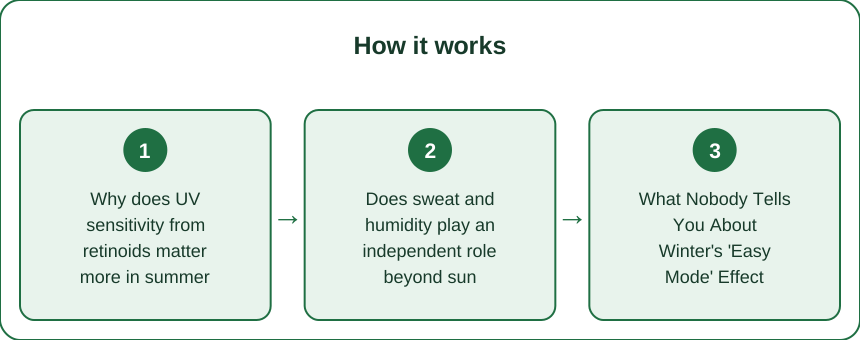
Why does UV sensitivity from retinoids matter more in summer specifically?
Retinoids increase skin’s sensitivity to sunlight as part of their normal mechanism, and summer brings both more UV intensity and typically more actual sun exposure time, so the same retinoid dose is effectively interacting with a much higher UV load than it was during winter, increasing the likelihood of visible irritation even with consistent sunscreen use.
Does sweat and humidity play an independent role beyond sun exposure?
Yes — sweat can interact with retinoid-treated skin in ways that increase irritation, particularly if application happens close to sweating activity, and higher humidity can also change how a product absorbs and sits on skin compared to the drier air of winter, sometimes increasing perceived intensity of the same formulation.
What Nobody Tells You About Winter’s ‘Easy Mode’ Effect
Winter’s naturally lower UV exposure and often more consistent indoor time can create a misleadingly smooth experience with a retinoid routine, making it easy to assume a particular strength or frequency is simply ‘well tolerated’ by your skin in general, when it may actually be well tolerated under winter conditions specifically. This sets up a common pattern: confidence built over a mild winter leads to no changes going into summer, right when the routine actually needs adjusting the most.

Does skin barrier function itself change with the seasons?
Somewhat — skin barrier function can already be under more stress in summer from increased sweating, higher UV exposure, and sometimes more frequent washing or swimming, meaning it’s starting from a slightly more compromised baseline before a retinoid’s own mild barrier effect is even added on top, compounding the irritation risk.
What’s a reasonable way to adjust a retinoid routine for summer?
Reducing application frequency slightly, applying at night with strict daytime sunscreen use, and paying closer attention to added barrier support (a richer moisturizer, avoiding other actives on the same nights) tends to keep summer irritation manageable without needing to stop the routine entirely.
FAQ: Seasonal Retinoid Sensitivity Questions, Answered
Should retinoid use be paused entirely during summer?
Not necessarily — many people can continue with adjustments (lower frequency, extra barrier support, diligent sunscreen) rather than stopping completely, though a temporary pause is reasonable if irritation becomes significant.
Does sunscreen fully offset the increased UV sensitivity from retinoids?
It substantially reduces the risk but doesn’t eliminate it entirely, especially with inconsistent reapplication, which is part of why summer retinoid irritation still happens even in people who wear sunscreen regularly.
Is it normal to need a different retinoid strength for different seasons?
Yes — adjusting strength or frequency seasonally is a common, reasonable approach rather than a sign the product or original routine was wrong.
TL;DR:
- Retinoids increase UV sensitivity, and summer brings more UV exposure to interact with
- Sweat and humidity can independently affect how a retinoid routine feels and performs
- A mild winter can create false confidence that doesn’t account for summer conditions
- Summer skin barrier function often starts from a more stressed baseline already
- Adjusting frequency and boosting barrier support usually resolves seasonal irritation
This is general information, not medical advice — persistent or severe irritation is worth discussing with a dermatologist.
Keep Reading
This article is for general informational and styling purposes only. Fit, sizing, and product availability may vary.