When the Heating Comes On, Your Retinoid Needs a Different Moisturizer
Quick Answer: Heated indoor air commonly drops below 30 percent relative humidity, and humectants like glycerin and hyaluronic acid work poorly or even draw water from your skin at that level unless sealed with an occlusive. Switching from a humectant-led moisturizer to one with real occlusive content is usually the whole fix.
Your retinoid routine has been stable since June.
The heating comes on for the first week and suddenly your face is flaking around the nose, from a product and a dose you have not changed.
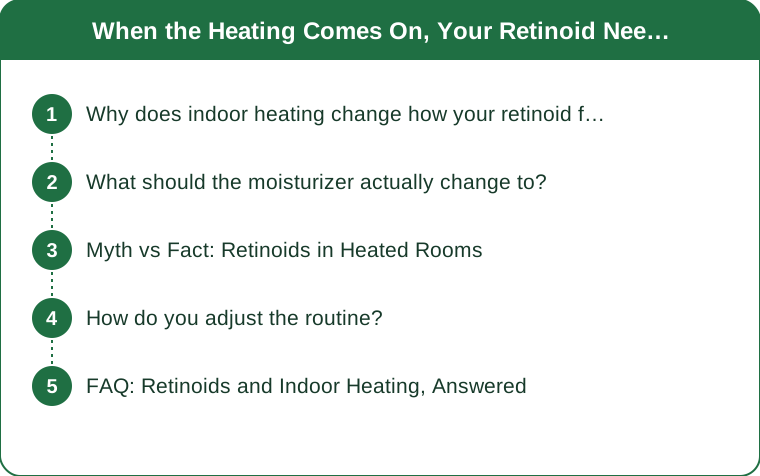
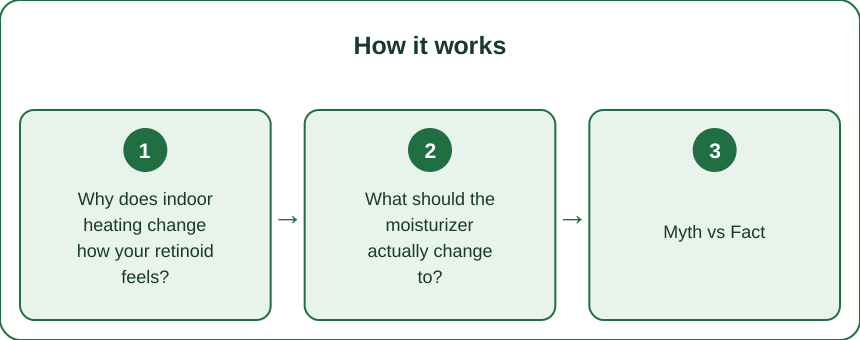
Why does indoor heating change how your retinoid feels?
Because the humidity it removes was doing part of your barrier’s job.
Heated air holds far less moisture. Warming cold outdoor air without adding water drops indoor relative humidity sharply — often to 20 to 30 percent, comparable to a desert. Skin loses water to that air continuously.
Retinoids temporarily compromise the barrier. They accelerate cell turnover, and during the adjustment period the barrier is measurably less effective at holding water. That is manageable at 50 percent humidity and much harder at 25.
Humectants can work backwards in dry air. Glycerin and hyaluronic acid pull water from the environment when there is water available, and from deeper in your skin when there is not. A humectant serum with nothing sealing it can leave you drier in a heated room.
Hot showers get longer as it gets colder. Hot water strips barrier lipids, and shower temperature rises with the season without anyone deciding to change it. This alone accounts for a lot of the winter irritation people attribute to their actives.
Your face is also going through temperature swings. Cold outdoors, hot indoors, repeatedly. That cycling stresses the barrier independently of humidity.
What should the moisturizer actually change to?
More occlusive, same humectants, and a change in when you apply it.
Add a genuine occlusive layer. Petrolatum, mineral oil, dimethicone, lanolin, or squalane. Occlusives reduce water loss substantially, and this is the single most effective change available for the season.
Keep the humectants and seal them. Do not drop the hyaluronic acid — apply it to damp skin and cover it with the occlusive so it has water to hold and somewhere to hold it.
Look for ceramides, cholesterol, and fatty acids. These are barrier-repair ingredients rather than surface seals, and they matter more in the season when the barrier is under the most stress.
Move to a cream or balm texture from a lotion or gel. Texture roughly tracks occlusive content. A gel moisturizer that worked in humid August is usually the wrong vehicle in a heated apartment.
Consider a sandwich application. Moisturizer, then retinoid, then moisturizer again. It reduces irritation with only a modest reduction in effect, and it is the standard adjustment for exactly this situation.
Myth vs Fact: Retinoids in Heated Rooms
Myth: You should stop your retinoid in winter. Fact: Winter is generally the easier season for retinoid use because of lower UV exposure. What needs to change is the moisturizer supporting it, not the active itself.
Myth: Flaking means the retinoid is working. Fact: Flaking means the barrier is compromised. Some adjustment is expected in the first weeks, and ongoing flaking months in is a signal to add support rather than a badge of efficacy.
Myth: Hyaluronic acid always hydrates. Fact: It moves water toward wherever there is less of it. In very dry air with nothing sealing it, it can draw water from deeper skin layers to the surface where it evaporates. Applied to damp skin and sealed, it does what you want.
Myth: A humidifier is a gimmick. Fact: It addresses the actual cause rather than compensating for it. Raising bedroom humidity to 40 to 50 percent measurably reduces overnight water loss, and it is often more effective than any product change.
Myth: If it stings, you should push through. Fact: Persistent stinging on previously tolerant skin means the barrier needs repair. Continuing at the same frequency through that is how people end up taking a month off entirely — the fourth mistake here is the one that costs the most progress.
How do you adjust the routine?
Change the support, then the frequency if needed.
Adjust the moisturizer first and give it two weeks. Most people find that is sufficient and no change to the retinoid is needed at all.
Reduce frequency temporarily if irritation persists. From nightly to every other night for two to three weeks, then build back. Reducing frequency preserves your tolerance better than stopping entirely.
Apply to fully dry skin, and wait. Damp skin increases penetration and increases irritation with it. Ten to twenty minutes after cleansing is the standard recommendation and it matters more in a dry season.
Lower the shower temperature and shorten it. Unglamorous and effective. Hot water is a larger contributor to winter barrier disruption than most product choices.
Run a humidifier in the bedroom at 40 to 50 percent. Eight hours of better humidity every night addresses the root cause. If irritation persists despite these changes, or you see redness that spreads or does not settle, see a dermatologist rather than continuing to adjust. This is general information, not medical advice.
FAQ: Retinoids and Indoor Heating, Answered
Should I switch to a heavier moisturizer for winter?
Heavier in occlusive content, yes — but keep the humectants and layer them underneath. The goal is to hold onto the water rather than just adding more product. A cream or balm over a humectant serum on damp skin is the standard structure.
Why did my retinoid start irritating me after months of being fine?
Most commonly the environment changed rather than your skin. Indoor heating, lower outdoor humidity, and hotter showers all arrive within the same couple of weeks and all stress the barrier. Same dose, harder conditions.
Does a humidifier actually help with retinoid irritation?
It addresses the cause directly, which few products do. Overnight is when most transepidermal water loss occurs and when your retinoid is on your skin, so raising bedroom humidity to 40 to 50 percent targets exactly the right window.
TL;DR:
- Heated indoor air drops relative humidity to 20 to 30 percent, which makes a retinoid-compromised barrier much harder to support.
- Humectants need to be applied to damp skin and sealed with an occlusive, or they can work against you in dry air.
- Change the moisturizer before you change the retinoid — two weeks is usually enough to tell.
- A bedroom humidifier at 40 to 50 percent addresses the cause more directly than any product swap.
Your retinoid did not get stronger this month. The air around it got a great deal thirstier.
Keep Reading
This article is for general informational and styling purposes only. Fit, sizing, and product availability may vary.