Why How Much Retinoid You Use Matters More Than the Strength
Quick Answer: Total retinoid delivered to your skin is concentration multiplied by amount. Doubling the quantity of a 0.25% product delivers more active than a careful pea-sized amount of 0.5% — so the amount you use is a bigger lever than the strength you bought. A pea-sized amount covers the entire face, and most people use two to three times that.
You moved up a strength because your routine plateaued, and now your skin is irritated. Or you moved up and nothing happened. Either way, the variable nobody adjusted is the one on the back of your hand.

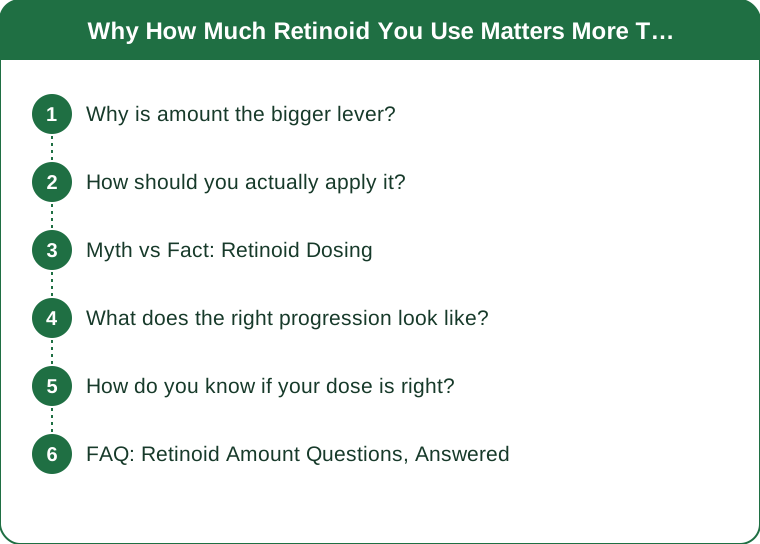
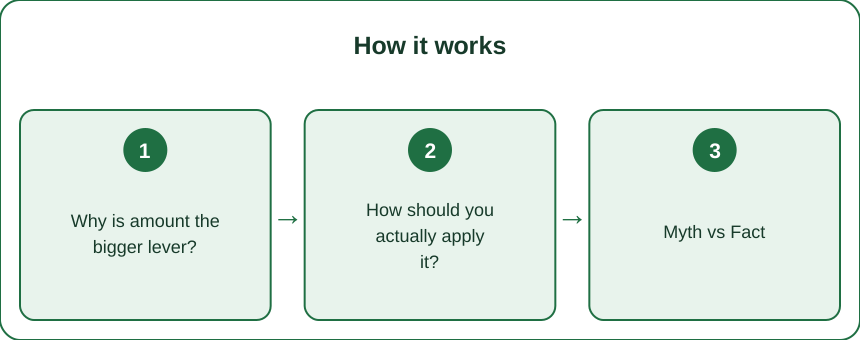
Why is amount the bigger lever?
Because dose is concentration times quantity, and quantity varies far more between people than concentration does between products.
The difference between a 0.25% and a 0.5% retinol is a factor of two. The difference between a careful pea-sized application and a generous three-pump application is easily a factor of three or four. The variable with the larger range is the one with the larger effect, and it is the one nobody measures.
There is a second reason it matters more than raw dose arithmetic suggests. Excess product does not increase penetration proportionally — the skin absorbs what it can, and the surplus sits on the surface. So a heavy application delivers more irritation for less additional benefit, which is the worst combination available.
The practical version: a pea-sized amount, about 0.25 to 0.5 ml, covers the entire face. If you are applying more than that, you are running a higher dose than the label suggests, and if your skin is irritated on a low-strength product, this is usually why.
How should you actually apply it?
A specific method, because technique changes the distribution as much as the quantity.
- Wait until skin is completely dry after cleansing — 10 to 20 minutes. Damp skin increases penetration, which sounds good and mostly means more irritation
- Dispense a pea-sized amount onto a fingertip. Not per area. For the whole face
- Dot it — forehead, each cheek, chin, nose
- Spread outward in thin layers, working from the dots. You should not be able to see or feel a wet film when you are done
- Avoid the immediate eye area, the corners of the nose, and the corners of the mouth, which are thin, occluded, and where irritation concentrates
- Wash your hands, since the residue on your fingers is a meaningful amount
On moisturizer: applying it before the retinoid (the sandwich method) reduces irritation and reduces potency somewhat. Applying it after is standard. Both are legitimate — the sandwich is the right choice while building tolerance, and worth stepping away from once you are established.
And frequency is part of dose. Two nights a week at a pea-size is a lower total dose than nightly at the same amount, which is why frequency is the better variable to increase first.
Myth vs Fact: Retinoid Dosing
Myth: More product means faster results. Fact: Beyond the amount your skin can absorb, additional product adds irritation without adding effect. And irritated, compromised skin tolerates less, so you often end up using it less often — a net reduction in total dose.
Myth: If it is not irritating, it is not working. Fact: This one causes real damage. Irritation is a side effect, not a mechanism. The cellular changes retinoids produce happen without visible peeling, and plenty of people get excellent results with no irritation at all.
Myth: Higher strength is the natural next step when results plateau. Fact: Increasing frequency at the current strength is usually the better first move, and it is gentler. Going from twice weekly to four times weekly is a larger dose increase than doubling the concentration while staying at twice weekly.
Myth: The neck needs the same amount as the face. Fact: Neck and chest skin is thinner, has fewer oil glands, and is considerably more prone to irritation. Use less, less often, and expect a slower build. A separate half-pea for the neck applied twice a week is a reasonable starting point.

What does the right progression look like?
Slow, and with frequency as the primary variable.
Weeks 1 to 4: twice weekly, pea-sized, moisturizer after. Do not change anything else in your routine during this period
Weeks 5 to 8: three times weekly if there is no persistent irritation. Same amount
Weeks 9 to 12: four to five times weekly. Same amount
Months 4 to 6: nightly, if tolerated. This is the destination for most people, and the strength has not changed once
Only after several months of comfortable nightly use is a strength increase a sensible consideration — and even then, drop back to three times weekly at the new strength and rebuild.
Things that reset your tolerance and are worth knowing about:
- A gap of more than a couple of weeks. Restart at a lower frequency rather than where you left off
- Adding another active — an exfoliating acid, vitamin C, benzoyl peroxide. Each one changes the barrier environment
- Seasonal change. Skin tolerates retinoids differently as humidity and temperature shift, and the transition out of summer is a common point for a routine to suddenly feel wrong
- Hot showers, sunburn, and travel, all of which temporarily compromise the barrier
How do you know if your dose is right?
Three signals, checked over weeks rather than days.
The dose is about right if:
- Mild dryness or flaking in the first few weeks that settles
- No persistent stinging on application after the first fortnight
- Skin looks and feels normal by morning
- You are able to maintain your intended frequency without skipping to recover
The dose is too high if:
- Persistent redness, tightness, or a burning sensation
- Flaking that does not settle after 6 to 8 weeks
- Skin that stings when you apply anything, including plain moisturizer — a sign of a compromised barrier
- You keep having to take several days off, which means your average frequency is lower than you think
The dose may be too low if:
- Six months of consistent use with no change in texture or tone at all
- Never any dryness, ever, even at the start
When in doubt, the correct move is almost always to reduce frequency and hold, rather than to stop entirely or to push through. Stopping loses the accumulated tolerance; pushing through a compromised barrier extends the problem.
This is general information rather than medical advice. Persistent irritation, severe reactions, or anything that is not settling with a reduced frequency is worth taking to a dermatologist, and prescription retinoids should be used as directed regardless of what a general guide says.
FAQ: Retinoid Amount Questions, Answered
Is a pea really enough for a whole face?
Yes. It looks like far too little, and it spreads further than you expect when applied to fully dry skin in thin layers. The near-universal experience of people who measure it properly is that they had been using two to three times as much.
Does it matter if it is a cream, serum, or oil?
The vehicle affects penetration and irritation meaningfully — the same percentage can behave quite differently in a rich cream than in a light serum. Which is another argument for holding your amount constant when you switch products, so you can tell what actually changed.
Should I use more on areas that need it most?
Generally no. Spot-applying more to a specific area concentrates irritation there without a proportional benefit, and uneven application produces uneven results. Consistent thin coverage across the whole area beats targeted heavy application.
TL;DR:
- Total dose is concentration times amount, and amount varies more between people than strength does between products
- A pea-sized amount covers the whole face; most people use two to three times that
- Increase frequency before strength — going twice to four times weekly outweighs doubling the percentage
- Apply to fully dry skin in thin layers, and use less on the neck and chest
The percentage on the bottle is the number everyone shops on and the smaller half of the equation. The other half is decided in the two seconds before you put it on your face.
Keep Reading
This article is for general informational and styling purposes only. Fit, sizing, and product availability may vary.