How to Tell If Your Retinoid Is Purging Your Skin or Just Breaking It Out
Quick Answer: Retinoid purging shows up as small, fast-turnover breakouts in areas you already tend to break out, typically resolving within 4-6 weeks as the retinoid speeds up cell turnover of blemishes that were already forming under the skin — a true breakout instead appears in new areas, doesn’t follow that timeline, and often comes with irritation, redness, or a burning sensation the purge alone doesn’t cause.
Three weeks into a new retinoid and your skin looks worse, not better. That’s either exactly on schedule or a sign to back off — the difference matters.

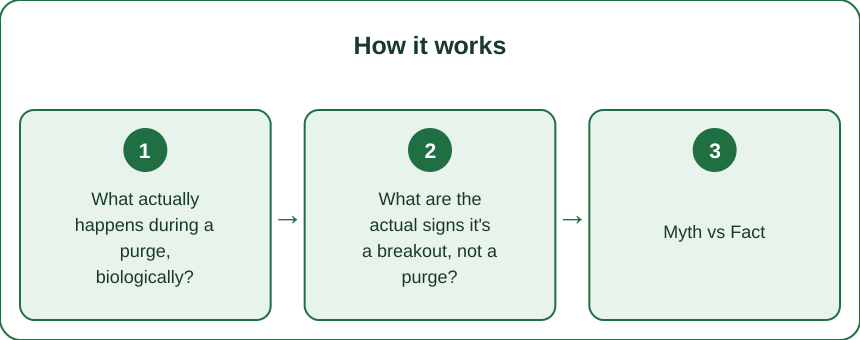
What actually happens during a purge, biologically?
Retinoids speed up skin cell turnover, which means blemishes that were slowly forming under the surface get pushed up and out faster than they would have naturally. This isn’t new damage — it’s existing, already-forming breakouts arriving on a compressed timeline. That’s why purging tends to happen in the same spots you’d normally break out anyway, just sooner and more concentrated.
What are the actual signs it’s a breakout, not a purge?
New blemishes in areas you don’t normally break out, breakouts that keep appearing well past the 6-week mark, or skin that’s also red, burning, or flaking heavily point toward irritation or a genuine reaction rather than purging. Purging is a temporary acceleration of your existing pattern; a real breakout or irritation reaction introduces something new to that pattern.

Myth vs Fact: Retinoid Purging
Myth: any breakout after starting a retinoid is purging. Fact: purging has a specific pattern (same areas, resolves in 4-6 weeks) — breakouts outside that pattern usually mean something else is going on. Myth: pushing through severe irritation is necessary for results. Fact: significant burning or peeling isn’t a required part of purging and is a sign to reduce frequency, not grit your teeth through it.
FAQ: Retinoid Purging Questions, Answered
How often should a new retinoid be applied at first?
Most dermatologists recommend starting 2-3 nights a week, not nightly, and increasing frequency gradually over several weeks as skin builds tolerance.
Should I stop using the retinoid if I think it’s purging?
Generally no — stopping and restarting can extend the purge process by resetting the adjustment period, whereas continuing through a genuine purge (at a tolerable frequency) tends to resolve faster.
When should someone actually stop and see a dermatologist?
If breakouts are worsening past 6-8 weeks, spreading to new areas, or accompanied by significant pain or swelling, that’s beyond typical purging and worth a professional look. This is general information, not medical advice.
TL;DR:
- Purging follows a pattern: same breakout-prone areas, resolves in about 4-6 weeks
- New areas, worsening past 6-8 weeks, or added burning/redness point to irritation instead
- Starting at 2-3 nights a week (not nightly) reduces the odds of a harsh reaction
- Stopping and restarting can extend a genuine purge rather than shortcut it
The calendar is the simplest test — if it’s not settling down by week six, it’s worth a second look rather than more patience.
Keep Reading
This article is for general informational and styling purposes only. Fit, sizing, and product availability may vary.